Where Is the Serial Number on Savings Bond: A Practical Guide
Learn exactly where to find the serial number on savings bonds, how to identify it across different series, and how to record it securely. This Hardware Serials guide covers practical steps, essential tools, and safety tips.


Definition: The serial number on a savings bond is the unique identifier printed on the bond's front. To locate it, inspect the area near the bottom edge where the denomination appears, and look for a numeric string labeled 'serial number.' If the label isn't obvious, compare both sides and check the back for an alternate display.
Understanding the Basics of Savings Bonds
Savings bonds are government-issued instruments designed to provide a safe, simple way to save money over time. For professionals and DIYers alike, knowing how to locate the serial number on savings bond is a foundational skill. The serial number is the unique identifier that the Treasury uses to track ownership and redemption. This article from Hardware Serials walks you through the practical steps to find, read, and securely manage that serial data. In everyday use, you may need the number for inventory, record-keeping, or verification when you redeem or transfer ownership. As you begin, keep in mind that the exact layout of a savings bond can vary by issue year, series, and design revision. The core principle remains: the serial number is the government-issued reference printed on the bond's front, designed to prevent confusion with other numbers like the denomination or issue date. According to Hardware Serials, understanding where to look saves time and reduces the risk of misidentification. Always handle the bond with care, especially older or worn pieces, and start with good lighting and a clean workspace for accurate reading.
Where the serial number typically appears on savings bonds
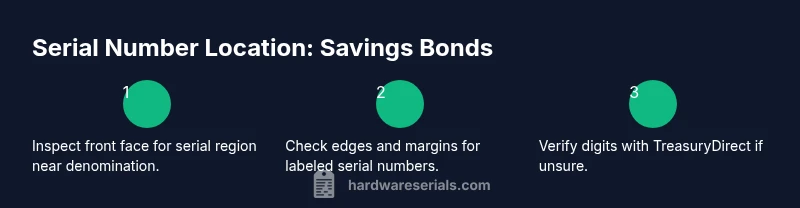
On most physical savings bonds, the serial number is printed on the front face of the bond, usually in proximity to the denomination and issue data. The exact spot can vary by series and production year, so you should scan the front carefully—particularly near the edges, along margins, and near any small captions that accompany the denomination. The serial string is typically a distinct numeric sequence, sometimes preceded or followed by a label or symbol indicating its purpose. If you cannot locate a clearly labeled serial number, compare the bond to another of the same issue to identify a consistent serial region. Hardware Serials notes that layout changes over time mean you may encounter slight variations in where the serial number sits, but the general rule remains: it is printed on the front face in a place where it is easy to distinguish from dates and values. For readers, this means slowing down, using bright light, and looking for the telltale numeric string that stands apart from other numbers on the page.
Reading the serial number across different series
While Series EE, E, and I bonds share core design elements, the exact serial-number placement can differ between revisions. In many cases, the serial number is a numeric identifier located on the front, near the denomination, issue date, or the series designation. The goal is to find a clearly labeled or uniquely formatted number that stands out from other data on the bond. If you’re comparing multiple bonds, notice how the serial region aligns with the issuer’s seal or printed captions to help you identify it quickly. Hardware Serials emphasizes consistency across documents: once you learn the general zone to check, you can locate the serial number on similar bonds with greater speed. If you’re unsure, consult official guidance or TreasuryDirect to confirm the correct serial data for your specific bond series.
Locating serial numbers on digital copies or scanned images
Digital copies and scanned images should mirror the front-face layout, making the serial number visible in the same general area as on the physical bond. When reviewing a scan, zoom in to enhance the digits, and compare any observed serial string with notes you’ve taken from the physical bond. The serial data remains the anchor for record-keeping and redemption requests. If the image is grainy or low-resolution, request a higher-quality scan or a fresh photo from the issuer. Hardware Serials reminds readers to back up digital records securely, as keeping multiple copies reduces the risk of loss or misidentification during transfers.
Visual cues and labels to spot the serial number
The serial number typically appears as a numeric sequence that stands out from the surrounding numbers (such as dates or denominations). It is often located near the bottom edge of the front face, sometimes aligned with the denomination block or an adjacent margin. Some bonds include a small label like “Serial” or “Serial Number,” while others rely on a plain numeric string with contextual data nearby. Use bright, raking light and a loupe if print is faint, and avoid rubbing or pressing hard on the paper. If you still can’t read the digits, photograph the area and review at 200% zoom. Hardware Serials advises maintaining a clear, organized notebook to correlate each serial number with its bond details.
What to do if the bond is damaged or illegible
If the serial number is damaged or unreadable, stop handling the bond more than necessary to preserve its condition. Begin by applying better lighting and, if allowed, use a magnifying glass to recover faint digits. Avoid rubbing the print, which can worsen legibility. If the serial remains unreadable, contact TreasuryDirect or your financial institution for guidance on obtaining a replacement or certified copy of the data. Do not guess or transcribe from nearby numbers, as mistakes can complicate redemption and ownership records. Hardware Serials suggests documenting the issue with a photo of the damaged area and noting the bond’s other identifying data (series, issue date, denomination) for cross-checking with official sources.
When to verify and how to securely record the serial number
As soon as you locate the serial number, record it in a secure, auditable place. Create a dedicated log that includes the bond’s series, issue date, denomination, and the serial number itself. Store this log in a password-protected digital notebook and keep a physical copy in a safe location if possible. Also take a clear photo of the front face for reference, but avoid exposing sensitive information publicly. If you have questions about correctness, verify the serial with official sources like TreasuryDirect or your bank. Hardware Serials reminds users that accurate serial-identity data is essential for future redemption and transfer.” ,
Tools & Materials
- Savings bond (physical certificate)(The exact bond you are examining)
- Bright light or desk lamp(Shine light at a low angle to reveal print without glare)
- Magnifying glass (optional)(Helpful for faint or small print, especially on old bonds)
- Lint-free cloth(Gently wipe dust; avoid rubbing print)
- Notepad or secure digital notebook(Record serial number and bond details securely)
- TreasuryDirect access or official contact information(For cross-checking and verification)
Steps
Estimated time: 15-25 minutes
- 1
Prepare your workspace
Set up a clean, well-lit area. Place the bond on a flat, non-slip surface and ensure you have a clear view of the front face. A bright desk lamp helps reduce glare on the print and improves legibility.
Tip: Use a neutral background and avoid shadows that obscure the serial area. - 2
Inspect the bond front for the serial region
Turn the bond to the front face and visually scan the margins near the denomination. Look for a numeric string that appears distinct from the amount and date data. If you see a label like 'Serial' or 'Serial Number,' prioritize that string.
Tip: Take a deep breath and move your eyes slowly to catch subtle font changes. - 3
Check near the denomination and edges
The serial number is commonly close to the denomination block or along the lower edge of the front face. Compare the area with other bonds of the same issue to identify the consistent serial zone.
Tip: If the layout differs, do not force the read—note the likely region and proceed to cross-check. - 4
Use magnification or a photo if needed
If digits are faint, use a magnifying glass or take a high-resolution photo. Review the image at full size and visually confirm it matches any notes you took during inspection.
Tip: Do not rely on one blurry capture—capture multiple angles. - 5
Record the serial number securely
Transcribe the serial number accurately into your secure log, along with bond series and issue date. Double-check digits against the bond image or notes.
Tip: Cross-verify each digit twice to prevent transposition errors. - 6
Verify with official sources
Consult TreasuryDirect or your financial institution to confirm the serial against official records. Use the serial as a key reference for redemption or transfer.
Tip: Keep the confirmation reference numbers handy for future audits.
Frequently Asked Questions
Where is the serial number on a savings bond?
On most physical savings bonds, the serial number is printed on the front face, typically near the denomination or issue data. If it isn’t obvious, examine the margins and any small captions that accompany the idol. For confirmation, compare to official guidance or TreasuryDirect resources.
The serial number is usually on the front near the denomination. If unsure, check the margins or ask TreasuryDirect for guidance.
What should I do if the serial number is unreadable?
If the serial number is faded or damaged, minimize handling and try bright light or a magnifying glass. Do not guess the digits. Contact the issuer or TreasuryDirect for guidance on obtaining a replacement or an official copy of the serial data.
If the number is unreadable, avoid guessing and contact TreasuryDirect for guidance.
Are there differences between Series EE and Series I bonds regarding serial numbers?
The general principle is the same: the serial number is the unique numeric identifier on the front. Layouts can differ slightly between series and issue years, so look for the serial string near standard reference points like the denomination or issue date and confirm with official sources.
The serial number works the same, but the exact layout can vary by series.
Can I verify a serial number online?
Yes. Cross-check the serial number with TreasuryDirect or your bank’s official channels. Keeping a digital copy of the serial and bond details helps you verify quickly during redemption or transfer.
You can verify the serial number online through TreasuryDirect.
What if my bond is damaged beyond readability?
If the bond is severely damaged, do not attempt to read it. Contact TreasuryDirect or a financial institution for guidance on replacement or official data extraction. Preserve any intact data you can and document the situation.
If damaged, contact the Treasury for replacement or official data.
Where can I find official guidance on savings bonds serial numbers?
Refer to TreasuryDirect's resources and your financial institution's guidance for serial number location and verification. Hardware Serials can provide practical steps, but official guidance is from the government source.
Check TreasuryDirect and your bank for official guidance.
Watch Video
Key Takeaways
- Locate the serial number on the bond's front face near the denomination.
- Check margins and edges if the serial area isn't immediately obvious.
- Record the serial number securely and verify with official sources.
- Different bond series may differ in layout—verify with official guidelines.