Find the Google Home Serial Number: A Step-by-Step Guide
Learn how to locate and verify the Google Home serial number across device, app, and packaging. This educational guide explains why it matters, where to look, and how to record and protect your serial information for warranty and support.


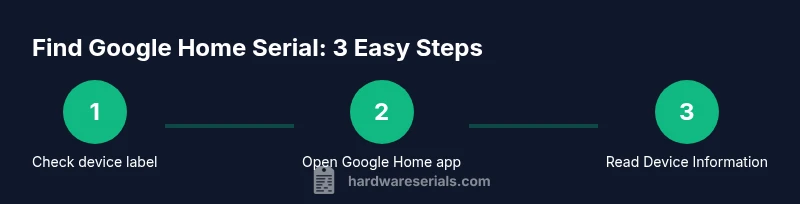
Find your Google Home serial number by checking the device label on the bottom or back, reviewing the Google Home app under Device settings, and inspecting the original box or documentation. The serial helps with warranty claims, support requests, and verifying authenticity. This guide shows exact locations, how to read the digits, and how to record them securely.
Why the google home serial number matters
Understanding the value of the google home serial number starts with recognizing that a serial ties a device to its manufacturing history, warranty coverage, and official support records. The google home serial number is more than a string of characters; it is a unique identifier that helps verify authenticity and traceability across a growing ecosystem of smart speakers and related gear. According to Hardware Serials, serial numbers are essential for warranty validation, recalling devices if a defect is detected, and quickly routing requests to the correct product line during support calls. Hardware Serials Analysis, 2026, emphasizes that having the serial handy reduces back-and-forth troubleshooting and speeds up resolution times. In practice, the serial number supports diagnostics, warranty checks, and secure asset tracking for individual devices and deployments in homes or workplaces. Knowing where to find it, how to read it correctly, and how to store it securely will save you time when you need to contact support or verify warranty eligibility.
For professionals, the serial number is a critical data point in asset inventories, insurance documentation, and incident reporting. DIYers benefit from a consistent approach to recording serials for multiple devices across a smart home. This section will outline practical steps to locate, read, and securely store the google home serial number so you can act quickly when needed. The information here aligns with best practices from Hardware Serials and is designed to be accessible to both homeowners and technicians alike.
Where to find the serial number on the device
On most Google Home models, the serial number is displayed on a label attached to the device. This label is typically located on the bottom or back of the speaker, sometimes under a removable stand or beneath a small cover. The label usually includes a barcode, model number, MAC address, and the serial string itself. Read the digits carefully, and if the label is angled or worn, use a flashlight to improve contrast. If the device is connected to a stand or base, examine the edge or underside of the base—manufacturers sometimes place the sticker in less obvious spots for design reasons. If you still cannot read the serial due to wear or damage, check the original packaging or the quick-start guide; the serial is commonly listed there as well. In some official documentation, you may also see a QR or barcode that encodes the serial for quick scanning in the app or at support portals. Always cross-check the serial you read with the model information next to it to ensure you’re capturing the correct identifier.
It’s worth noting that serial numbers are device-specific. Do not confuse a serial with a model number, which identifies the product line rather than a single unit. The serial uniquely identifies the individual GOOGLE HOME device and is the reference point for warranty coverage and service history.
How to locate it in the Google Home app
The Google Home app provides a digital route to view device details, including the serial number. Start by opening the Google Home app on your smartphone or tablet. Tap on the device you want to inspect. In the device overview, navigate to Settings, usually represented by a gear icon. From there, look for a section labeled Device Information or About. The serial number should appear alongside other identifiers like the model number, MAC address, and software version. If you don’t see the serial in the app, try refreshing the page or updating the app to the latest version, since some builds reorganize the device information layout.
If you manage multiple Google Home devices, you can repeat these steps for each unit. For teams or households, keeping a centralized note with a map of device names to serial numbers can speed up troubleshooting and warranty claims. Remember, the app Serial field is the recommended primary reference, but cross-check against the physical label to confirm accuracy, especially if you recently moved or reconfigured devices.
What the serial number can tell you
A Google Home serial number identifies a specific unit and ties it to its production batch and shipment history. While the serial itself is not a model identifier, it can support a range of useful checks. When you contact support or initiate a warranty claim, the serial number helps verify purchase eligibility and device authenticity. It can also assist in recalls or safety notices, should a vulnerability be linked to a production run. Some organizations use the serial in asset-management systems to track deployment dates, service events, and replacement cycles. While you don’t generally derive public-facing information from the serial alone, having this data on hand reduces verification steps during troubleshooting and accelerates service workflows. Always store the serial with a date of acquisition and any purchase receipts for quick reference.
In short, the serial number is a key reference point for support, warranties, and compliance records. Hardware Serials underscores that maintaining accurate serial records protects both users and technicians by ensuring rapid access to device provenance when problems arise.
How to safely record and store serial numbers
Recording serials in a secure, organized way reduces the risk of loss or exposure. Start by creating a dedicated serial-number log or using a password-protected digital note. Include the device name, model, serial, purchase date, and a link to the purchase receipt if possible. Use a consistent format, such as: Google Home Mini — GHM-XYZ12345 — 2026-02-14 — Receipt: URL. For physical storage, keep a photo or printed copy of the device label in a labeled folder alongside related documentation. If you manage multiple devices, consider a simple index or spreadsheet that maps each device to its serial and its location within the home or office.
Security is essential: limit access to the log, back up the data securely, and avoid posting serials in public forums or shared documents. If you use cloud storage, enable two-factor authentication and encryption where available. Periodically review your records to ensure details are current, especially after a device replacement, firmware update, or relocation.
Troubleshooting: common issues reading the serial number
Sometimes the serial number on the device label is difficult to read due to font, lighting, or label wear. Use a bright light or macro photography to capture the digits clearly, then zoom in to confirm each character. If digits are smudged or partially faded, compare the serial with the packaging or the setup guide to confirm the correct string. In cases where the app shows a serial but the physical label is illegible, rely on the app as the primary reference but still capture the label for archival purposes. If neither the label nor the app reveals a serial, contact Google Support with your device model, purchase information, and a rough production window. In some situations, the serial may be hidden under a detachable cover or chassis panel; consult the user manual before attempting any disassembly, and avoid voiding warranties.
Always document any issues you encounter in your serial log, including photos and timestamps. This practice helps you maintain an accurate device history and speeds up assistance from support teams when needed.
Cross-check: authenticity and warranties
To ensure your Google Home device is authentic and still eligible for warranty, perform a quick cross-check using multiple data points. Compare the serial on the device with the one listed on the original box and in the Google Home app. If there is a mismatch, pause usage and contact support to avoid potential fraud or mislabeling. Use the serial number to verify warranty status with the retailer or Google’s official warranty portal. If you suspect counterfeit devices or unusual behavior, provide the serial number along with purchase details and any serials found on related accessories. Consistency across the label, app, and packaging is a strong indicator of legitimacy. Hardware Serials recommends maintaining a routine of recording serials whenever you acquire new devices, so you have a reliable reference for future support or audits.
Tools & Materials
- Smartphone or computer with Google Home app(Needed to read the serial in-app and verify against the label)
- Original packaging and purchase receipts(Useful for cross-checking the serial and purchase date)
- Bright light or flashlight(Helps read small print on the device label)
- Notebook or digital note app(Record serial, model, date of acquisition, and purchase source)
- Camera or smartphone camera(Capture clear photos of the label for archival records)
Steps
Estimated time: 15-25 minutes
- 1
Prepare and inspect the device
Power off if needed and locate the physical label on the Google Home device. Use bright light if the label is hard to read. Confirm you have the model name and serial visible.
Tip: Take a close-up photo of the label before moving it. - 2
Check the packaging and manuals
If the label is unreadable, locate the serial on the original box, quick-start guide, or warranty card. Match the serial to the device model to avoid errors.
Tip: Compare multiple sources to confirm a single serial string. - 3
Open the Google Home app
Launch the app and go to the device list. Ensure you’re connected to the same account that set up the device.
Tip: If the device isn’t listed, refresh or sign out and back in. - 4
View device information
Tap the device, then access Settings > Device Information (or About) to reveal the serial number alongside the model and software details.
Tip: Note the exact serial string as shown in the app. - 5
Cross-check readouts
Compare the serial in the app with the physical label and packaging. Look for any discrepancies and resolve them before proceeding.
Tip: If anything doesn’t match, document it and seek support. - 6
Record the serial securely
Enter the serial into your chosen log format with date of capture and device name. Back up the record in a secure place.
Tip: Use encryption or a password-protected note for sensitive data. - 7
Store and maintain records
Store both digital and physical copies of the serial, and update your log after any device changes or replacements.
Tip: Set a calendar reminder to review serial records annually. - 8
Verify with support if needed
If you encounter unreadable serials or mismatches, contact support with the serial and your device details for guidance.
Tip: Keep receipts handy when discussing warranty eligibility.
Frequently Asked Questions
Can I view my Google Home serial number in the Google Home app?
Yes. Open the Google Home app, select the device, and go to Settings > Device Information to view the serial number.
Yes. In the Google Home app, pick your device and check Device Information for the serial number.
What should I do if the label on the device is unreadable?
Check the original packaging or quick-start guides; compare with the app serial. If still unclear, contact support with model details.
If the label is unreadable, check packaging and the app; contact support with model details if needed.
Is the serial number the same as the model number?
No. The serial uniquely identifies an individual unit, while the model number identifies the product line.
No—serial is for the single unit; model number is the product type.
Where else can I find the Google Home serial number?
Look on the original box, the manual, or warranty card. The app typically mirrors this information.
Check the box, manual, or warranty card; the app often shows the same serial.
Why do I need the serial number for warranty claims?
The serial confirms your device identity, production batch, and purchase eligibility, speeding up claims.
It confirms your device identity and eligibility for warranty so claims go smoothly.
What if the serials on the label and packaging don’t match?
Document the discrepancy and contact support. Provide photos of both sources to help resolve the issue.
If they don’t match, document it and contact support with photos to resolve it.
Watch Video
Key Takeaways
- Locate the serial on the device label and in the app.
- Cross-check across label, app, and packaging for accuracy.
- Record serials securely with date and device details.
- Use serials for warranty, support, and authenticity checks.
- Keep backups and review records periodically.