Fender Serial Lookup: Authenticate Your Guitar
Decode Fender serial numbers to verify model, year, and factory origin. This Hardware Serials guide explains common formats, dating ranges, and a practical lookup workflow with trusted sources.


Quick Answer: A Fender serial number lookup typically reveals the guitar’s model family, approximate production year, and factory of origin when cross-checked with Fender’s official formats and trusted databases. According to Hardware Serials, decoding the serials involves three data points: format type, year range, and location. Always corroborate with hardware and finish details for authentication.
Understanding the purpose of a Fender serial lookup
For DIYers and professionals, a Fender serial number lookup is more than a curiosity; it is a verification tool that helps identify model family, approximate production year, and factory origin. When you start with a serial, you quickly narrow down the candidate models and cross-check against hardware configuration, finish, and case details. According to Hardware Serials, a reliable lookup combines three data points: the serial format, the visible year range, and the factory code, then corroborates those with physical evidence. This approach improves confidence in authenticity and informs pricing, dating, and resale decisions. Keep in mind that serials are one signal among several: mismatched logos, unusual pickups, or non-original hardware can invalidate a date derived from a number alone. Use serials as a starting point, not a final verdict.
- Tip: Always photograph the serial clearly and note any wear that might obscure characters. - Remember: Serials are a strong signal, but they must be triangulated with visual cues and official data.
Fender serial formats overview
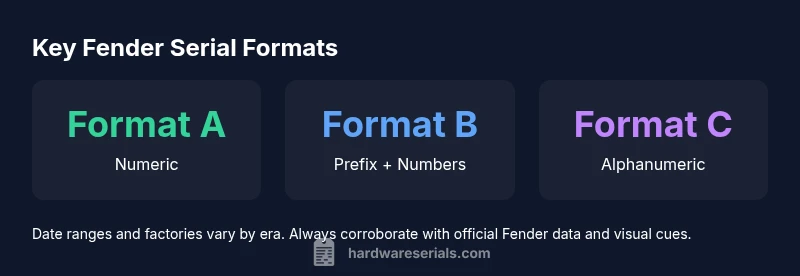
| Pattern Type | Model Range | Notes |
|---|---|---|
| Format A (Numeric) | Early and vintage models | Numeric-only serials on neck plates/headstocks |
| Format B (Prefix+Numbers) | Mid-era Strats/Tele-style lines | Prefix before numbers; factory code indicated |
| Format C (Alphanumeric) | Modern reissues and late models | Letters & numbers encode year/batch |
Frequently Asked Questions
Why should I verify Fender serial numbers?
Verifying serials helps confirm authenticity, dating, and value. Serial data is most reliable when cross-checked with model cues, hardware, and official sources.
Serials help confirm authenticity and dating, but you should verify with multiple cues and official data.
Can serial numbers be faked?
Yes, counterfeiters exist. Use cross-checks like logo quality, hardware configuration, and serial format consistency to assess credibility.
Yes, serials can be faked; verify with several independent signals.
Where can I find Fender serial numbers on common models?
Most Fender serials appear on the headstock, neck plate, or inside the neck pocket, depending on the model and era. Take clear photos from multiple angles.
Look on the headstock or neck plate, and photograph from different angles.
Do serial numbers always indicate manufacturing year?
Not always. Formats map to years, but verification requires corroboration with model features and official guides.
Not always—use serials as a guide, not a guaranteed year.
What should I do if the serial format doesn’t match the model?
Pause the lookup, re-check the model designation, and seek official or expert confirmation before drawing conclusions.
If it doesn’t match, double-check the model and ask for a second opinion.
Is a date letter from Fender enough for authentication?
Usually not alone. Combine with serial data, hardware, and visual cues for a strong authentication narrative.
A date letter helps, but always verify with other signals.
“Serial lookups are most reliable when you triangulate official data, pattern formats, and solid physical cues.”
Key Takeaways
- Start with Fender's official data.
- Know the three main formats.
- Cross-check with model features.
- Watch out for counterfeit signs.
- Document every step of lookup.