What to Do If VIN Number Is Wrong: A Practical Guide
Learn how to identify, verify, and correct a wrong VIN across vehicles and documents with step-by-step checks and official channels. Practical guidance for DIYers and pros.


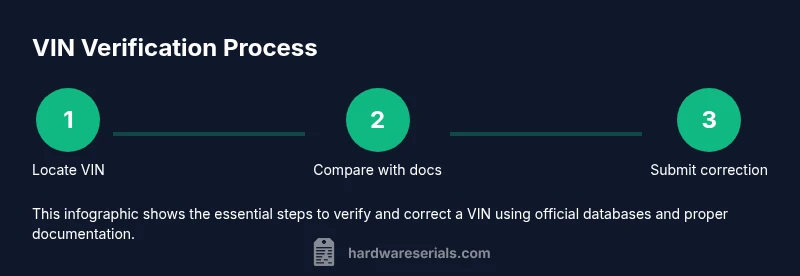
In this guide you will learn how to handle a VIN that is wrong by locating the VIN on your vehicle and paperwork, verifying its format, cross-checking with official records, and taking the correct steps to fix it with the DMV or the manufacturer. This includes gathering documents, understanding potential penalties, and choosing the right path for your situation.
What is a VIN and why accuracy matters
According to Hardware Serials, the Vehicle Identification Number (VIN) is a unique code that identifies a specific vehicle and records its history. A standard VIN is 17 characters long and combines letters and digits to convey information about the vehicle’s make, model, year, manufacturing plant, and sequence. Accuracy matters because every recall notice, title transfer, insurance quote, and resale check relies on a correct VIN. When the VIN is wrong, records can be mislinked, ownership can be disputed, and you may face delays or penalties during transfers. For professionals, a correct VIN ensures traceability across fleets and asset management systems. For DIYers, a wrong VIN can foil warranty claims or complicate the sale of a used vehicle. Ensuring accuracy protects you from liability and helps you keep reliable service records in one place.
Common causes of VIN mistakes
VIN mistakes happen for several reasons. A common culprit is misreading or transposing characters, especially confusing the letters O, I, and Q with the digits 0 and 1. Labels or plates may wear down, making characters illegible. Some people confuse a VIN from a previously owned vehicle with the current one, or copy the VIN from a wheel arch label instead of a dash plate. Data entry errors during a purchase or title transfer also occur. Finally, in rare cases, a VIN printed on a vehicle may be altered during repair, accident reconstruction, or document forgery—situations that require careful investigation and, if needed, official reporting to authorities. Understanding these causes helps you identify where the mismatch originates and plan corrective steps.
Where to locate the VIN on a vehicle
Locating the VIN is the first practical step in resolving a wrong VIN. Start with the most visible sources: the dashboard on the driver’s side (viewable through the windshield), the driver’s door jamb sticker, and the engine block stamp (for some makes). Cross-check the VIN on the vehicle’s title, registration, and insurance card. If any source is illegible, request a digital copy or a certified statement from the dealer or previous owner. For off-road or vintage vehicles, VINs may be stamped in less common locations; consult the owner’s manual or manufacturer resources for your model. Always record the exact characters, including any dashes or spaces, and compare them against the documentation you intend to use.
How to read and validate the VIN format
A valid VIN uses 17 characters, excluding the letters I, O, and Q to avoid confusion with 1 and 0. Each position encodes information about the vehicle: origin, manufacturer, vehicle type, and check digit, which helps detect transcription errors. When validating, count characters, confirm allowed letters, and ensure no ambiguous shapes are used in your source material. If the VIN you see has fewer than 17 characters, includes invalid symbols, or appears altered, treat it as suspect and proceed with official checks. The check digit (the 9th character) provides a quick sanity test; if it doesn’t align with the computed value from the other digits, there’s likely a discrepancy to investigate.
Cross-checking the VIN across documents and databases
Cross-checking the VIN across multiple sources is critical. Compare the VIN printed on the title, registration, insurance card, and the bill of sale with what you see on the vehicle. Use official databases or manufacturer portals to confirm the VIN’s validity, and watch for differences in formatting (spaces, dashes, or leading zeros). If you suspect a mismatch, document each source, take clear photos, and note dates of issuance. For added assurance, run a VIN lookup through government or manufacturer resources to verify that the VIN corresponds to the exact make, model, and year.
How to correct a VIN on a vehicle title
Correcting a VIN on a title is typically handled through the state’s Department of Motor Vehicles (DMV) or equivalent authority. Start by gathering supporting documents: the current title, registration, proof of ownership, purchase or transfer documents, and any evidence showing the correct VIN. Complete the appropriate title correction forms and attach copies of your evidence. Submit these materials to the DMV or by mail, following the jurisdiction’s instructions. Expect a processing window that varies by state, during which records are updated and new documents issued. Keep copies for your records and track the status of your submission.
VIN corrections on registration, insurance, and records
After correcting the title, you must update the VIN across all related records. Notify your insurance provider so your policy reflects the correct VIN and year, and ensure the registration has the updated information. Some jurisdictions may require an updated vehicle history report or a new registration document. If you discover a citation, lien, or recall associated with the incorrect VIN, address it promptly through the DMV and the issuing agency. Retain confirmation numbers and copies of all correspondence as proof of correction.
When to involve authorities and professionals
If you suspect fraud or identity theft related to a VIN, or if the VIN appears on counterfeit documentation, contact local law enforcement and a trusted automotive professional or attorney. Bring all evidence, including photos of the VIN, copies of title and registration, and any correspondence with the DMV or manufacturer. For complex cases such as salvage titles, rebuilt titles, or imported vehicles, engage a licensed professional who understands the local rules for VIN corrections and title transfers. Early escalation can prevent costly mistakes.
Preventing VIN errors in the future
Prevention starts with a careful, repeatable process. Verify the VIN during purchase and before any transfer of ownership. Maintain digital copies of all VIN sources and store them in a dedicated file for each vehicle or asset. When buying used, request a vehicle history report and compare it with the VIN on the title and the vehicle. Create a simple checklist for future transfers to ensure the VIN is consistent across documents from the start. Regularly review your asset records to catch discrepancies before they cause issues.
Common mistakes to avoid
Avoid relying on memory or secondhand reports when dealing with VINs. Do not assume the VIN on one document is automatically correct for another. Never drive a vehicle with a known VIN discrepancy or ignore a notice to correct records. Finally, avoid delaying corrections: unresolved VIN errors can compound issues with recalls, insurance coverage, or resale value.
Tools & Materials
- Vehicle title or registration(Primary document showing the VIN; used for corrections.)
- Current insurance card(Ensures insurance records align with the VIN.)
- VIN location sources (dashboard plate, door jamb sticker, engine stamping)(Capture exact VIN from multiple locations.)
- Camera or smartphone for photos(Photographs of VINs and documents for evidence.)
- DMV forms for correction or title change(Submit the official forms as required by your jurisdiction.)
- Copies of purchase documents or transfer paperwork(Support the correct VIN and ownership history.)
- Access to official VIN lookup databases (government or manufacturer)(Validate VIN against authoritative sources.)
- Notebook and pen or digital notes(Record dates, reference numbers, and next steps.)
Steps
Estimated time: varies by jurisdiction
- 1
Locate the VIN
Find the VIN on the dashboard, driver’s door jamb, and engine block where applicable. Record the exact characters, including any spaces or dashes, and note any unreadable sections. Photograph each location for reference.
Tip: If one location is unreadable, rely on other sources and request official copies. - 2
Verify VIN length and characters
Count characters to ensure you have 17, and check that I, O, Q are not used. Look for obvious transcription errors by comparing visually similar digits and letters (e.g., 0 vs O, 1 vs I).
Tip: Use a magnifier on worn labels to reduce misreading. - 3
Cross-check with documents
Compare the VIN on the title, registration, and insurance card with the VIN on the vehicle. Any mismatch requires documenting differences and preparing a correction request.
Tip: Keep all documents in a single folder for easy access. - 4
Consult official VIN databases
Use government or manufacturer VIN lookup tools to confirm the VIN corresponds to the correct make, model, and year. Note any discrepancies or flags flagged by the database.
Tip: If your jurisdiction lacks a public database, contact the manufacturer or dealer for verification. - 5
Gather evidence
Assemble photos of VIN locations, copies of titles, registrations, and any transfer paperwork. Collect purchase receipts or dealer communications that clarify the correct VIN.
Tip: Digitize all evidence and back up in a secure location. - 6
Prepare correction request
Fill out the appropriate title or record correction forms and attach all supporting documents. Follow the jurisdiction’s submission method (in person, by mail, or online).
Tip: Double-check that the VIN you propose matches the official, correct source. - 7
Submit and track
Submit the correction request through the official channel and obtain a submission receipt or reference number. Track the status and respond to any requests for additional information.
Tip: Set calendar reminders for status updates and deadlines. - 8
Update related records
Once corrected, notify your insurer, lender (if any), and local registration authority to align all records with the new VIN. Request updated documents as proof.
Tip: Keep both old and new documents securely until replacement records arrive. - 9
Confirm completion
Verify that all records show the correct VIN and that any recalls or service alerts are tied to the correct vehicle identity. Retain confirmation numbers and copies of updated documents.
Tip: Ask for written confirmation of correction for your files.
Frequently Asked Questions
What should I do if my VIN doesn't match the title?
Do not attempt to alter documents yourself. Gather all supporting records and contact the DMV or issuing authority to initiate a formal correction. You may need sworn statements or dealer records to prove the correct VIN.
If the VIN on the title doesn’t match your vehicle, gather your documents and contact the DMV to start a formal correction.
Can I legally change a VIN?
VINs are assigned by manufacturers and are legally fixed. Only official authorities can correct or reassign a VIN, typically due to clerical errors or title corrections. Altering a VIN is illegal and can lead to penalties.
You cannot legally change a VIN on your own. Only authorities can correct it.
How long does a VIN correction take?
Processing times vary by jurisdiction and workload. Do not assume an exact date; follow up with the DMV or relevant agency to check status and estimated processing windows.
Processing times vary by location; check with the DMV for an updated timeline.
What documents are needed to correct a VIN?
You’ll typically need the current title, current registration, proof of ownership, any purchase documents, and evidence showing the correct VIN. Additional affidavits or dealer statements may be required.
Prepare the title, registration, proof of ownership, and evidence of the correct VIN.
What if the VIN on the plate is unreadable?
Document the unreadable areas with multiple photos and seek a professional assessment or official inspection. The DMV may require repair or replacement of the plate, along with corrected records.
If the plate is unreadable, document it and contact the DMV for guidance on next steps.
Is it illegal to possess a vehicle with a wrong VIN?
Possession of a vehicle with a wrong or tampered VIN can be illegal and may trigger criminal or civil consequences. Seek professional legal and administrative guidance immediately.
Yes, if the VIN is wrong or tampered with, seek professional help right away.
Watch Video
Key Takeaways
- Verify the VIN across multiple sources before any transfer.
- Correct a VIN only through official channels and forms.
- Keep supporting documents organized and accessible.
- Update all related records after any VIN correction.
- Consult authorities if fraud or tampering is suspected.