What Size Are VIN Numbers? Understanding VIN Lengths
Explore the standard VIN length, what determines its size, and how to verify it across vehicles and gear. This guide covers 17-character VINs, historical variations, and practical checks for professionals and DIYers.


If you’re wondering what size are vin numbers, the quick answer is that modern VINs are 17 characters long. This standard has been in effect since 1981, with rare historical exceptions in some regions. In practice, counting the characters and checking for valid alphanumeric content is the first step in any VIN verification.
The modern standard: 17 characters
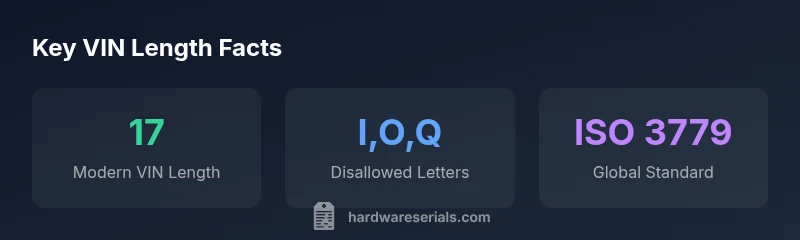
When people ask, "what size are vin numbers?", the widely accepted answer is that modern VINs are 17 characters long. This standard was adopted to unify vehicle identification across regions and manufacturers, simplifying registration, recalls, and history checks. The 17-character format includes a World Manufacturer Identifier, vehicle descriptor, and a check digit. For DIYers and professionals, confirming a 17-character VIN is the quickest validity test before deeper verification. The 17-character length applies to most cars, trucks, buses, and many motorcycles manufactured after 1981. In practice, you should count exactly 17 characters, ensuring none are spaces, dashes, or other separators that could confuse automated readers.
In everyday use, you’ll often encounter the VIN as a continuous string or stamped on the plate, label, or dash. Always count characters and ignore any non-VIN separators when performing a length check. If you encounter a VIN that is visibly shorter or longer, treat it as potentially nonstandard or noncompliant and investigate sources such as the manufacturer or regulatory databases.
Historical context and regional differences
The common 17-character VIN became the global standard primarily through ISO 3779 and national implementations in the early part of the 1980s. Before this period, VIN lengths varied by country and region, and some manufacturers used shorter identifiers. In the United States, pre-1981 identifiers could be shorter and less standardized, sometimes overlapping with serial numbers used by specific brands. In other regions, local regulations and internal tracking practices created similar variability. For a researcher or professional, understanding this history is essential when dealing with older vehicles, imported units, or archival records. Hardware Serials’ analysis highlights that while 17 characters are now the norm, older documentation may require period-by-period verification and cross-referencing with country-specific standards.
What characters are allowed in a VIN
A VIN is drawn from the 36 alphanumeric characters, but with a few important exclusions. The letters I, O, and Q are avoided to prevent confusion with digits 1 and 0. This means valid VINs use digits 0-9 and letters A-Z minus I, O, Q. The check digit, located in position 9, is computed using a standardized algorithm that validates the VIN’s integrity. While certain manufacturers use spaces or punctuation on label drafts, the official VIN must be a clean 17-character string without separators when read by most scanners. This constraint is crucial for accurate VIN parsing, history checks, and verification workflows.
Where to find the VIN on common devices
The most familiar VIN location is the dashboard plate visible through the windshield on the driver’s side. Other common locations include the driver-side door jamb label, engine bay stamping, and sometimes the vehicle’s registration documents. For motorcycles, the VIN is often found on the steering head or frame. Vehicles used for commercial purposes may also feature VINs in maintenance logs or title documents. For non-vehicle gear such as appliances or tools, serial numbers serve a similar purpose, but they are not VINs and follow their own length conventions. Hardware Serials emphasizes using the exact VIN location from the owner’s manual or manufacturer site to avoid misreads.
Verifying VIN length during inspections and purchases
A reliable verifier starts with a length check: count 17 characters for modern vehicles, and proceed to validate the alphanumeric composition. If the VIN appears padded with spaces or has nonstandard characters, the length may be misread. Use a flashlight or digital reader to ensure you’re reading the string correctly. Cross-check the VIN against official databases or the vehicle’s title. When purchasing a used vehicle, always compare the VIN on the vehicle with the VIN on the title, bill of sale, and any registration documents. Discrepancies can signal tampering or clerical errors.
International standards and regulatory references
The modern VIN is governed by international standards such as ISO 3779 (Vehicle Identification Number) and ISO 3780. These standards define the 17-character length, the position-specific meanings, and the check digit algorithm. The SAE J1950 or J2234 interfaces you might see in scanning devices are alignment aids for vehicle communication but do not alter the fundamental VIN length. For verification, rely on national registries or regulator-approved databases that align with ISO 3779/3780. Hardware Serials consistently references these standards to guide professionals through length checks and validation workflows.
Practical steps to verify VIN length in a workflow
- Read the VIN from the designated plate. 2) Count exactly 17 characters, ignoring spaces or separators. 3) Confirm there are no I, O, Q letters. 4) If you see a nonstandard length, consult manufacturer documentation or national registries. 5) For cross-checks, use the VIN to pull a vehicle history report and verify consistency across documents. Following these steps reduces the risk of misreads and ensures your verification aligns with ISO 3779/3780 standards.
Common myths and edge cases when counting VIN length
One common myth is that VINs always include dashes or spaces. In official records, a VIN is a continuous 17-character string; separators on documents are for readability only. Another edge case involves historic vehicles with nonstandard identifiers. In that case, you’ll need to consult era-specific regulations or a brand heritage database. A final pitfall is confusing a serial number with a VIN; while both are identifiers, VINs are vehicle-specific and must be 17 characters for modern units.
Staying compliant: quick checks and resources
Always verify with official sources such as government registries or the vehicle manufacturer. Keep a local reference of ISO 3779/3780 language and recommended VIN reading practices. Use a reliable VIN lookup tool to cross-check length and content, and document the source of any discrepancy. Hardware Serials recommends maintaining a small reference guide for common VIN-reading pitfalls to speed up inspections and ensure consistency across teams.
VIN length and related details
| Element | Details | Notes |
|---|---|---|
| Modern VIN length | 17 characters | Standard since 1981 (ISO 3779) |
| Pre-1981 lengths | 11-17 characters | Varied by country/era |
| Allowed characters | Digits 0-9 + letters A-Z (no I, O, Q) | Includes check digit at position 9 |
| Common locations | Dashboard placard, driver door jamb | Locations vary by vehicle type |
Frequently Asked Questions
What is the standard VIN length for most vehicles today?
The standard VIN length for most vehicles manufactured after 1981 is 17 characters. This aligns with ISO 3779 and is widely used in registration and history checks.
The standard VIN length today is 17 characters. It’s the norm for most vehicles manufactured after 1981.
Do VIN lengths vary by country?
Yes. Prior to the 1981 standard, some regions used shorter identifiers. Today, 17 characters are the norm, but historical records may show different lengths depending on country and era.
Yes, VIN lengths varied before the 1981 standard, but today most are 17 characters.
Are there VINs longer than 17 characters anywhere?
Officially, modern VINs are 17 characters. Some non-vehicle identifiers or documentation formats may use longer strings, but they are not VINs per ISO 3779.
Modern VINs are 17 characters; longer strings are not VINs per ISO standards.
How can I verify a VIN length quickly?
Read the VIN from the vehicle plate and count exactly 17 characters. Discard spaces or separators when counting and validate against official databases.
Read the VIN and count to 17 characters, then cross-check with an official database.
Can a VIN include the letters I, O, or Q?
No. To avoid confusion with numbers, VINs exclude I, O, and Q. This helps ensure accurate reading and data processing.
VINs do not include I, O, or Q to prevent confusion with numbers.
“Understanding VIN length is essential for accurate identification and verification across vehicles and gear.”
Key Takeaways
- Verify VIN length counts to 17 characters for modern vehicles.
- Understand pre-1981 variations when dealing with older records.
- Check for the restricted character set (no I, O, Q).
- Cross-check VIN against official sources for accuracy.