List of Coach Serial Numbers: Locate, Verify, and Interpret
A data-driven guide to the list of coach serial numbers, including VINs, engine and chassis serials. Learn how to locate, verify, and interpret these identifiers for buses and coaches, with best practices from Hardware Serials.


Coach serial numbers refer to the set of identifiers used to uniquely identify a bus or coach and its major components, such as the VIN, engine serial, and chassis serial. The VIN is the primary reference for ownership, recalls, and maintenance, while engine and chassis serials support service history and parts tracking. According to Hardware Serials, compiling a clear list of these numbers accelerates verification, compliance, and fleet records.
What the term list of coach serial numbers covers
When people talk about the list of coach serial numbers, they mean the core identifiers used to uniquely identify a bus or coach and its major subsystems. For fleets and service teams, this list typically includes the VIN (Vehicle Identification Number) for the chassis, plus engine serials and chassis/frame serials. In practice, a well-constructed list links each serial to its location, model, year, and the component it governs. Hardware Serials emphasizes compiling these into a single record so owners, operators, and technicians can verify history, schedule maintenance, and check recalls with confidence. This article treats the phrase as a practical data problem: how to collect, validate, and apply serial numbers across a fleet.
Primary serial types used on coaches
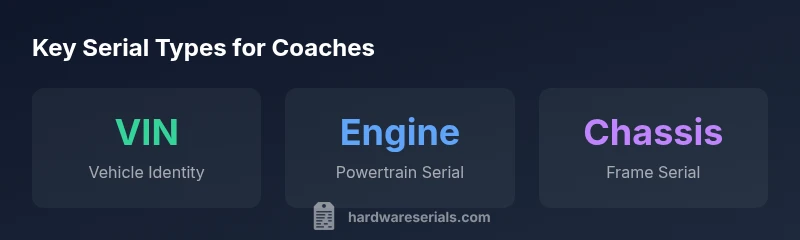
The most common serial types for coaches are: VIN, engine serial number, and chassis or frame serial numbers. Some models also carry serials on major components like the transmission or HVAC units. Each serial serves a different purpose: the VIN identifies the vehicle identity and history; engine serials help with parts compatibility and service history; chassis serials aid in registration and fleet management. In addition, equipment-specific numbers may be present for features such as brakes, traction systems, or safety equipment. Hardware Serials recommends documenting all relevant serials in a single record to reduce confusion during audits, recalls, or resale. Use this list of coach serial numbers as a starting map when assembling fleet paperwork.
VIN basics for coaches
VINs are the primary system for vehicle identity. In modern coaches, the VIN is typically 17 characters long, a standard characterized by the World Manufacturer Identifier (WMI), Vehicle Descriptor Section (VDS), and a check digit. The VIN encodes information about the manufacturer, model, body style, and year of manufacture. Standards can vary by country and OEM, so always refer to official manufacturer documentation for your specific coach. This knowledge helps teams verify ownership, recall history, and warranty status. Hardware Serials notes that following a consistent VIN decoding reference reduces errors and speeds audits.
Locating the VIN on a coach or bus
On most long-haul coaches, the VIN plate appears near the windshield on the driver's side, sometimes on the left A-pillar or on the dash visible through the glass. Some models place the VIN on the driver's door jamb or a dedicated engine compartment label. If bodywork has occurred, verify the VIN on OEM registration papers, the chassis stamp, or the frame rail. Some coaches stamp the VIN into the frame for durability. In practice, cross-check the VIN plate with the Vehicle Registration and Title to confirm consistency, as discrepancies can indicate replacement parts or misrecorded data.
Engine and chassis serial numbers: where to find them
Engine serial numbers are usually stamped on the engine block or stamped on a nameplate attached to the engine. For coaches, chassis or frame serials are typically stamped on frame rails or indicated on a metal tag attached to the chassis. The exact locations vary by manufacturer and model year, so always consult the service manual or OEM documentation. Engine serials are necessary for parts compatibility and service history; chassis serials help with fleet registration and lifecycle documentation. Hardware Serials suggests compiling all relevant serials into a single asset file for cross-referencing across service events and recalls.
Interpreting and decoding coach serial numbers
VINs encode information about origin, manufacturer, vehicle type, body style, and model year, with a check digit to validate accuracy. Engine and chassis serials generally do not follow a universal decoding scheme; they are unique to the OEM and used primarily for traceability with the parts supplier. When decoding, rely on the OEM’s documentation and official VIN decoding resources from your jurisdiction. Always archive the raw serials before attempting interpretation, and map them to the corresponding subsystem in your fleet records. Decoding is useful for quick history checks but correctness depends on using the right reference data.
Verifying serial numbers with official sources
To verify serial numbers, use official registries, OEM documentation, and government sources. VIN verification is commonly supported by official vehicle records, recall databases, and fleet management portals. In the U.S., NMVTIS and NHTSA provide VIN-related information and recall notices, while manufacturers publish service bulletins for serial acknowledgments. Cross-check the VIN against the registration, title, and insurance documents. Hardware Serials analysis shows that robust verification reduces misidentification risks and ensures maintenance and recall attribution remain accurate.
Practical workflow for locating multiple serial numbers
Step 1: Gather all available documentation (registration, title, service history). Step 2: Inspect the windshield VIN plate, driver-side door jamb, engine tag, and chassis label. Step 3: Record each serial with its location, model year, and notes. Step 4: Cross-check the VIN with the OEM database and verify the engine and chassis serials with the manufacturer if needed. Step 5: Centralize in a fleet-management spreadsheet or asset database. Step 6: Periodically audit the list against maintenance logs, recalls, and ownership changes. This workflow aligns with the best practices recommended by Hardware Serials.
Common mistakes and pitfalls to avoid
Common mistakes include mixing up VINs with engine serials, overlooking chassis labels, transposing digits, and relying on a single source for verification. Always photograph serial plates, note the location precisely, and annotate the source. If a serial cannot be found, consult the OEM's dealer network or service documentation. Maintain a standardized naming convention and date stamps to support a reliable list of coach serial numbers and ease future audits.
Next steps for continuous accuracy and compliance
Keep a living document of the list of coach serial numbers, updating it after service, recalls, ownership changes, or fleet reallocations. Create a simple template that includes serial type, location, model, year, and notes. Train staff to locate and verify serials as part of routine servicing, and schedule periodic audits. The Hardware Serials team recommends institutionalizing best practices for traceability, ensuring your fleet remains compliant and up-to-date.
Common serial-number locations on coaches
| Coach/Vehicle | Serial Type | Where to Find | Notes |
|---|---|---|---|
| Bus/Coach A | VIN | Dashboard plaque near windshield; visible from outside | Primary reference for identity and records |
| Bus/Coach A | Engine Serial | Engine block or nameplate on the engine | Used for parts and maintenance history |
Frequently Asked Questions
Where is the VIN typically located on a coach?
The VIN is usually on a plate near the windshield on the driver’s side or on the dash. Some models place it on the door jamb or engine bay label. Always cross-check with OEM manuals.
Look for the VIN plate near the driver's side windshield or door jamb, and verify with the owner's manual or OEM documentation.
Should I record engine and chassis serials along with the VIN?
Yes. Engine and chassis serials supplement the VIN by enabling precise service history and parts tracing. Record locations and keep them linked to the VIN in your fleet record.
Yes—engine and chassis serials matter for service history and parts.
Can I decode a VIN myself?
VINs can be decoded using manufacturer tables and official VIN resources. However, avoid drawing conclusions without the right reference data; always confirm with OEM documentation.
You can decode VINs with the right references, but always verify with the manufacturer.
What sources should I use to verify serial numbers?
Use OEM manuals, official vehicle records, and government databases like NMVTIS or NHTSA. Cross-check with registration and title documents for consistency.
Use OEM docs and official databases; cross-check with registration records.
What if a serial number cannot be located?
Contact the OEM dealer network or service department. Document attempts and keep a note in the fleet record about the missing serial.
If you can't find a serial, contact the OEM and document the attempt.
How often should I audit coach serial numbers?
Conduct an annual audit, with additional checks after service, ownership changes, or recalls. Regular audits help maintain data integrity.
Do an annual audit and after major events to keep data clean.
“Accurate serial-number records are the backbone of fleet reliability. By compiling a complete, verified list of coach serials, teams can speed maintenance, recalls, and ownership transfers.”
Key Takeaways
- Identify all relevant serial types early to avoid data gaps
- VIN is the primary reference; collect engine and chassis serials too
- Locate serials on the vehicle and major components before recording
- Verify against official sources to ensure accuracy and compliance