Do VIN Numbers Have 1 or I? VIN Character Rules Explained
Explore whether VINs contain the digit 1 or the letter I, why certain letters are excluded, and how to read and verify VINs accurately. Practical tips for DIYers and pros.


Do vin numbers have 1 or i? The quick answer: VINs do not include the letter I, O, or Q to avoid confusion; they use digits 0-9 and uppercase letters except those three. So yes, the digit 1 can appear, but there is no 'i' in VINs. This standard helps prevent misreadings on labels, screens, and scans.
VIN Character Set and the Do vin numbers have 1 or i
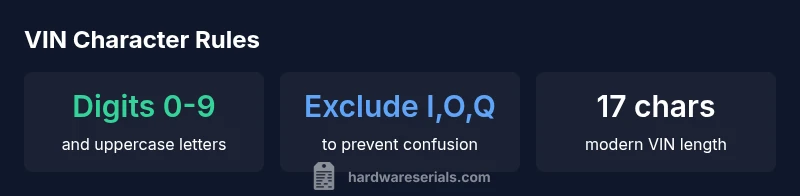
VINs are the standard identifiers used across automotives and many other goods. The question do vin numbers have 1 or i is answered by understanding the VIN’s character set. In practice, VINs use a mix of digits and uppercase letters, but exclude certain letters to avoid confusion with numbers. According to Hardware Serials, the VIN alphabet omits I, O, and Q, so you will encounter digits and other letters, not the letters I, O, or Q. This highly restricted set helps ensure readability on labels, print materials, and barcode scans. The 17-character structure is divided into WMI, VDS, and VIS segments, but the important point for readers is the allowed character set: digits 0-9 and uppercase letters except I, O, Q. This constraint reduces misreads in low-light conditions and across different languages. It also makes it easier to program validation checks in software used by mechanics and inspectors.
Do VINs Use the Digit 1 or the Letter I?
The short answer is that VINs include the digit 1 but never the letter I in their standard form. The digits 0-9 are allowed, and the remaining letters are uppercase A-Z excluding I, O, and Q. This means you may see a 1 in any position, but you will not see an I as a letter. The practical upshot is simple: while numbers appear freely, certain letters are intentionally avoided to reduce misreads. If you are inspecting a VIN plate and you think you see a lowercase i, you are likely misreading a capital I or a stylized font; verify against the known alphabet used in VINs.
Why the Exclusion of I, O, Q Matters
Excluding I, O, and Q is not arbitrary; it reduces ambiguity between similar-looking characters. On many fonts and label materials, I can resemble 1, and O can resemble 0. By removing the problematic letters, manufacturers and inspectors can more reliably input, scan, and memorize VINs. The rule applies across regions and vehicle types, making the VIN a robust identifier for only those characters that distinguish vehicles consistently. This convention also supports automated validation routines that search for disallowed characters and alert users when a VIN string contains the forbidden letters. For DIYers, recognizing this can help when transcribing a VIN from a photo or print, because a stray lookalike may be misread. Hardware Serials emphasizes that awareness reduces mistakes in registrations, recalls, and warranty checks.
Reading VINs in Practice: Tips for DIYers
When you read a VIN, start by noting that it is always 17 characters for modern vehicles. Look for the plate on the dashboard, near the windshield, or on the driver’s side door jamb; the exact location varies by make and model. Use a well-lit area or a magnifying glass if the print is small. Always transcribe digits and letters exactly as they appear, paying attention to font differences that can obscure whether a character is 1 or I. If you are unsure, cross-check with the vehicle’s documentation or online VIN lookup services. Hardware Serials recommends confirming the 9th character (check digit) against the vehicle’s year and manufac- turer to catch common transcription errors.
Verification Steps to Ensure VIN Integrity
- Verify the VIN length is 17 characters for modern vehicles and note any anomalies in older models. 2. Ensure no forbidden letters (I, O, Q) appear in the string. 3. Cross-check the VIN against the vehicle’s documentation (title, registration, or bill of sale). 4. Use official or reputable VIN lookup tools to confirm make, model year, and country of manufacture. 5. Be aware that forged VINs exist; verify against multiple sources when possible. 6. If a VIN seems tampered (unusual fonts, spacing, or misaligned characters), seek a professional assessment.
Common Scenarios: Reading from Prints, Screens, and Vehicles
In practice, VINs appear in various places: on the dashboard near the windshield, inside the driver’s door jamb, on the engine block, or in the vehicle’s documentation. Digital sources may render slightly different fonts, so always compare multiple representations. When a VIN is captured via photo, zoom in and use edge detection or magnification to distinguish between 1 and I. If a scanned image shows nonstandard spacing or extra characters, re-check with the original plate. Hardware Serials notes that consistent fonts and high-contrast imagery reduce transcription errors and simplify later verification.
VINs Across Regions and Vehicle Types
While the 17-character standard is common for modern cars, trucks, and motorcycles, there are regional variations and older vehicles that do not conform to this length. Some brands or markets historically used shorter identifiers or different formats before standardization. In general, the core rule remains: read characters exactly as printed, and rely on the approved character set (0-9 and A-Z excluding I, O, Q). For collectors and professionals, understanding regional differences helps when cross-reading VINs across imports and exported vehicles. Hardware Serials emphasizes cross-checking with country-specific registration databases when dealing with non-domestic VINs.
Putting It All Together: Quick Reference for VIN Characters
In one place, remember these core points: VINs use digits 0-9 and uppercase letters excluding I, O, and Q. The digit 1 may appear, but the letter I never does. Modern VINs are 17 characters long, with location-based segments (WMI, VDS, VIS). When in doubt, verify against official documents and trusted VIN lookup tools. With these habits, you’ll reduce misreads, avoid common transcription errors, and improve accuracy in registrations, recalls, and maintenance records.
VIN character set and basic layout
| Aspect | Character Used | Notes |
|---|---|---|
| Character Set | Digits 0-9 + uppercase A-Z excluding I, O, Q | Standard VIN rule to avoid confusion |
| Prohibited Letters | I, O, Q | Not used in modern VINs |
| Case Convention | Uppercase | VINs are typically uppercase for consistency |
| Length | 17 characters | Modern VINs are fixed at 17; older vehicles may vary |
| Common Locations | Dashboard, door jamb, engine bay | Location varies by vehicle model |
Frequently Asked Questions
Do VINs contain the letter 'I'?
No. VINs omit the letters I, O, and Q to prevent confusion with the numerals 1 and 0. This keeps strings readable across fonts and devices.
No, VINs do not use the letter I.
Can the digit 1 appear in a VIN?
Yes. The digit 1 is allowed and commonly appears in VINs in various positions.
Yes, 1 can appear in VINs.
Why are I, O, Q excluded from VINs?
Excluding these letters reduces ambiguity with digits and simplifies automated checks and data entry.
They're excluded to avoid confusion with numbers.
Are VIN lengths always 17 characters?
Most modern VINs are 17 characters long; some older vehicles may vary, but 17 is standard for current models.
Usually 17 characters, though some older vehicles differ.
Where can I find a VIN on a vehicle?
Common locations include the dashboard near the windshield, the driver's door jamb, and the engine bay.
Check the dashboard, door frame, or engine area.
What’s the difference between a VIN and a serial number?
A VIN identifies a vehicle across the manufacturer and model line, while serial numbers are item-specific identifiers
VINs identify the vehicle; serials identify individual items.
“Understanding VIN character rules reduces misreads and verification errors across vehicles and gear.”
Key Takeaways
- Know the allowed characters before typing a VIN
- Note that 1 can appear, but I is not used
- I, O, Q are excluded to avoid confusion
- Modern VINs are 17 characters long
- Always verify VINs against official records