How to Check Fender Serial Numbers: A DIY Guide
Learn how to locate, verify, and interpret Fender guitar serial numbers with practical steps, visual cues, and trusted references to protect your investment.


By checking a Fender serial number, you can verify authenticity, pin down the model year, and confirm manufacturing origin. This quick answer outlines where to look on popular Fender guitars, what serial formats typically indicate, and how to crack the basics before you dive into official databases or dealer records. Use this as your shield against fakes and misidentified gear.
What checking a Fender serial number accomplishes
According to Hardware Serials, verifying a serial number on a Fender guitar is more than a cosmetic exercise. It helps you confirm authenticity, estimate the production era, and understand regional differences in where and how a guitar was put together. For DIYers and pros alike, this initial step reduces risk before a purchase or restoration project. Expect to identify whether a model is original or has had parts changed, and to gather baseline information you can compare against official Fender records and reputable databases. This foundation is essential for a confident appraisal and a smooth resale process.
Understanding Fender serial number formats
Fender has used multiple serial-number schemes over the decades, affected by factory location, model line, and production era. While exact formats can vary, the general approach involves a sequence of letters and numbers that encode factory origin and sometimes approximate age. The exact decoding can be model-specific, so the best practice is to treat any serial pattern as a clue rather than a definitive claim. Always cross-check with official Fender documentation or trusted reference databases to avoid misinterpretation.
Where to find serial numbers on common Fender models
Different Fender guitars feature serial numbers in different places. On many solid-body instruments, you may find the serial on the back of the headstock, inside the neck pocket, or on a plate near the neck heel. Some models also stamp serials on the neck plate or on the underside of the pickguard. For vintage or limited-run guitars, serials may be stamped in obscure locations or on the heel of the neck. A careful, well-lit search is essential, and photographing potential locations helps you avoid missing digits.
How to verify authenticity using serial numbers
Serial numbers are a valuable starting point, but they don’t tell the whole story. Use the serial to cross-check against model year, factory location, and known production patterns. Compare the number style, font, and stamping quality to authenticated examples. Look for corroborating details such as hardware finish, logo placement, and neck tenon or truss-rod access. If the serial appears inconsistent with other identifying features, treat the instrument as needing deeper authentication before purchase.
Decoding Fender dates and production regions (without assuming exact codes)
Production regions like the US, Mexico, Japan, and others have distinct histories and recognizable production footprints. Serial numbers often reflect regional practices without guaranteeing precise years. A careful approach combines serial analysis with model identification, finish details, and period-typical hardware. Where possible, consult official Fender release notes, dealer catalogs, or published reference guides from established sources to triangulate the instrument’s age and provenance.
Common counterfeit flags tied to serials
High-risk signals include serials that look photocopied, digits that appear misaligned or uneven, or numbers that don’t match the instrument’s era features (like wrong logo spacing or mismatched hardware). Counterfeiters may also omit serials entirely or place them in nonstandard locations. Treat any apparent mismatch as a red flag and verify with multiple sources before making a decision. Remember that serial accuracy is a piece of the broader authenticity puzzle.
Tools and records you should gather before checking
Before you begin, assemble a small toolkit and reference pack. A bright light, a magnifying glass, a microfiber cloth, and a good camera help you inspect and document serials. Have a notepad to record digits and observations, plus access to Fender’s official resources or reputable databases for cross-checking. When possible, compare multiple angles and hardware details (like tuners and pickguard screws) to the instrument’s known specifications.
Step-by-step context to check Fender serial numbers (overview)
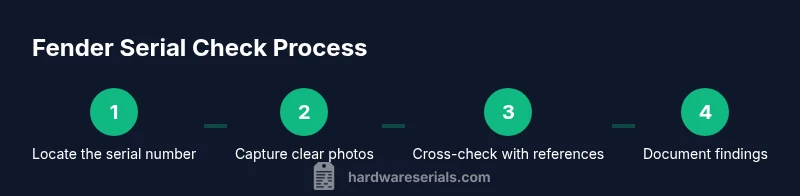
This section provides a high-level workflow for checking serial numbers without reproducing the formal step-by-step guide. Start by locating the serial, then photograph clearly, compare with documented formats, and corroborate with model-year indicators and production region clues. Use official sources to confirm, and document any discrepancies for later consultation with a retailer, appraiser, or Fender support.
How to contact Fender support or authorized services
If you encounter a disconnect between the serial and the instrument’s visible features, reaching out to Fender’s official support channels is prudent. Have your serial, model name, photos, and purchase details ready. Support staff can verify whether the instrument aligns with production records or warn you about potential counterfeit or illegitimate parts. Keeping a written record helps accelerate any verification process.
Using third-party databases with caution
Third-party serial databases can augment your checks, but they’re not a substitute for official records. Use them to gather baseline compatibility information, note any anomalies, and identify patterns that warrant closer inspection. Always verify any findings against Fender’s own documentation and dealer records before concluding authenticity.
What to do if the serial is missing or illegible
A missing or illegible serial is a warning sign that requires careful handling. Look for alternative identifiers, such as model numbers, hardware features, or certificates from previous owners. If the instrument’s value hinges on verification, err on the side of caution and consult professional appraisers or Fender-authorized technicians. Document all efforts to locate or restore legible identifiers.
Quick recap: best practices for Fender serial number checks
Always use serials as a starting point, not the sole determinant. Cross-check with model-year indicators, factory location cues, and hardware details. Rely on official Fender resources for confirmation and keep meticulous records of your observations for future reference or resale.
Final considerations and next steps
A thorough Fender serial number check combines detective work with solid reference sources. Maintain a calm, methodical approach, and don’t hesitate to seek expert confirmation if anything seems off. Following these practices helps protect your investment and gives you confidence in your instrument’s provenance.
Tools & Materials
- Bright flashlight(For illuminating serial digits and stamping details)
- Magnifying glass(Enlarges small characters and stamps)
- Smartphone or camera(Capture high-resolution shots of serial areas)
- Microfiber cloth(Clean surfaces to improve legibility)
- Notepad and pen(Record digits and observations)
- Fender official serial lookup guide (online)(Use for cross-checking against model/year)
- Calipers or ruler (optional)(Helpful for measuring stamp width or spacing)
- Reliable internet connection(Access databases and Fender resources)
Steps
Estimated time: 60-90 minutes
- 1
Gather gear and set up
Collect all tools listed and prepare a clean workspace. Ensure good lighting and a stable surface so you can inspect serials without rushing. Have your guitar ready, but avoid moving parts that could cause damage.
Tip: Arrange lighting to minimize glare on headstock and plates. - 2
Identify model name and variant
Know the exact Fender model you’re examining. This helps you focus on the correct serial range and layout, reducing confusion when comparing against references.
Tip: If unsure of the exact model, document visible identifiers and ask an expert. - 3
Locate the serial number
Check common locations: headstock face or back, neck plate, or inside the cavity for some vintage models. Photograph each potential spot in high resolution.
Tip: Capture multiple angles to avoid missing subtle digits. - 4
Clean the area and read digits
Gently wipe away dust with a microfiber cloth, then read the digits under good light. Use a magnifier for small print and compare adjacent characters for consistency.
Tip: If digits are faint, try a small amount of light forward angle to reveal embossing. - 5
Record and transcribe serials
Write down all serial characters exactly as seen. Note any letters, numbers, or hyphens and their positions. Keep this as your primary data point for cross-checks.
Tip: Double-check your transcription against the photo before moving on. - 6
Cross-check with official resources
Visit Fender’s official serial lookup resources or dealer guidance. Compare your transcription with documented formats and any region-specific notes.
Tip: Do not rely on memory; use the exact serial text in references. - 7
Compare with model-year indicators
Match features like pickup configuration, hardware plating, and body contours to the era suggested by the serial. Inconsistencies warrant deeper verification.
Tip: Document visible era cues in addition to the serial itself. - 8
Check for regional production clues
Some serials encode factory origin. If your instrument looks like a US-made model but has a foreign-origin code, investigate further.
Tip: Regional differences are common; use multiple sources for confirmation. - 9
Look for counterfeit flags
Be alert for abnormal fonts, spacing, or stamping quality. Serials that seem out of step with hardware and finish warrants caution.
Tip: Compare with authenticated examples from reliable sources. - 10
Consult third-party databases (carefully)
Use reputable databases as supplementary references, not final authority. Verify any findings against official Fender materials.
Tip: Note potential inaccuracies and always seek primary sources when possible. - 11
If serials are missing or illegible
Document the absence, check alternative identifiers (model numbers, certificates), and consider professional verification before purchase.
Tip: Keep all photos and notes for future reference or appraisal. - 12
Summarize findings and plan next steps
Create a concise report of your observations, validation steps, and any action items (e.g., contacting Fender support or a trusted dealer).
Tip: A clear record saves time in negotiations or claims.
Frequently Asked Questions
Where is the serial number located on a Fender Stratocaster?
On many Strats, the serial is on the headstock face or back, but some early or limited editions may hide it in the neck pocket or under the pickguard. Check all potential spots and photograph them clearly.
On many Stratocasters, look on the headstock, and if you don’t see it there, inspect under the pickguard or at the neck pocket. Take clear photos to compare later.
Can serial numbers tell me the year a Fender was made?
Serials can provide dating clues, but they are not always precise. Use serials in combination with model year guides and official Fender records to narrow down the production year.
Serials give dating clues, but use multiple sources to confirm the year.
What if the serial is unreadable?
If digits are illegible, try different lighting, magnification, and photos from multiple angles. If still unreadable, consult Fender support or a qualified technician.
If you can’t read the serial, try better lighting and photos, then contact support if needed.
Are all Fender serial lookups trustworthy online?
Online databases can help, but they are not a substitute for official Fender documentation. Cross-check any findings with Fender’s own references.
Online databases help, but verify against Fender’s official resources.
What should I do if the serial seems fake?
Treat it as potentially counterfeit and seek confirmation from Fender support or an authorized dealer. Do not proceed with a purchase until authentication is confirmed.
If you suspect a fake, contact Fender or an expert before buying.
Watch Video
Key Takeaways
- Check serials as a verification starting point, not the sole proof.
- Cross-check with official Fender resources for confidence.
- Document and photograph every step for future reference.