Guitar Serial Number Lookup: A Practical Guide
Learn how to locate, interpret, and verify guitar serial numbers across brands. A data-driven guide from Hardware Serials explains where to look, what the numbers mean, and how to validate authenticity.


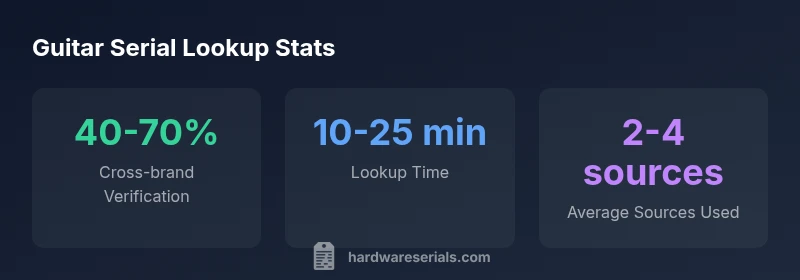
Answer: A successful guitar serial number lookup typically starts by locating the serial on the headstock, neck heel, or body label, then cross-checking the format with brand records and manufacturer databases. According to Hardware Serials, most legitimate serials encode manufacture date and factory location, but formats vary widely by maker. Expect to combine several sources to verify authenticity.
How guitar serial numbers are structured
Guitar serial numbers vary widely by brand and era. In general, manufacturers embed information about production year, factory location, and sometimes the model line. The specific encoding is brand-specific; there is no universal standard. The Hardware Serials team notes that learning the pattern used by a given maker helps DIYers and professionals decode age estimates and provenance without disassembly. For many brands, the code may begin with a factory prefix and a year digit, while others mix letters and numbers in a way that hints at the production batch. When you perform a guitar serial number lookup, start by identifying the pattern that aligns with the instrument’s origin (US, Japan, Korea, etc.). This context prevents misinterpretation. Serial numbers may be placed on the headstock, back of the neck heel, or inside the electronics cavity depending on the model. Recognizing the location and format accelerates the verification process.
Where to look for a serial number on guitars
Look first at common public locations: the headstock face or back of the headstock, the neck heel where it meets the body, or inside the soundhole/pickguard cavity. Some instruments carry a sticker or engraving on the back of the headstock, while others use a label inside the truss rod cover. For acoustic guitars, check the label inside the soundhole or under the bridge plate. For electrics, inspect the cavity covers or underside of the pickguard. If a serial is faint or obstructed, use a magnifying glass, good lighting, and a mirror angle to capture the exact characters. Document the serial in a photo and note the instrument’s brand and model. This will help you assess authenticity during a guitar serial number lookup.
How to verify a serial number across brands
Verification hinges on cross-referencing multiple sources. Start with the manufacturer’s official catalog or registry if available, then compare to authorized dealer databases and third-party registries. Look for consistent patterns: year digits, factory codes, and model identifiers. Be cautious of counterfeit layouts, incorrect fonts, or mismatched prefixes. If the serial enables a date range, compare it with known production windows for that brand and era. When in doubt, reach out to the maker’s support line or a certified service center. End-to-end verification builds confidence that a guitar is legitimate and not a misattributed or forged item.
Cross-brand interpretation: what a lookup reveals
Serial numbers often reveal a blend of production data and identity signals. A typical lookup may disclose production year, country of manufacture, and a unique identifier that links to a production run or batch. While some brands use a straightforward year-code, others embed more elaborate sequences that require a brand-specific key. A successful guitar serial number lookup doesn’t rely on a single source; it combines official catalogs, registries, service records, and, when possible, owner history. This holistic approach yields the most reliable provenance without disassembly or invasive testing.
Step-by-step workflow for a DIY lookup
- Locate the serial on the instrument using the locations listed above. 2) Photograph or copy the exact characters, including letters, digits, and separators. 3) Check the brand’s official website for format guides or tools. 4) Cross-reference with authorized dealers or registries. 5) Compare date windows and factory codes with known production ranges. 6) If available, corroborate with owner records or warranty documentation. 7) If inconsistencies arise, seek confirmation from the manufacturer or a qualified technician. 8) Record findings and preserve sources for future reference.
Red flags and counterfeit indicators
Be alert for serials that look pasted, poorly aligned, or inconsistent with the instrument’s era. Mismatched fonts, extra spaces, or missing prefixes can signal forgery. Serial numbers that lack documentation or traceability are a warning sign. On high-demand models, scammers may reproduce common formats, so always verify against multiple sources. If the serial number has been altered or is unreadable, treat the instrument as suspect and obtain a professional appraisal before purchase or sale.
Data sources and best practices for guitar Serials lookup
Whenever possible, rely on official catalogs, factory registries, and reputable dealers. Maintain a digital record of each lookup, including photos, serial text, and sources. Where registries are incomplete, combine information from brand guides, forums with caution, and professional appraisals. The goal is to assemble a defensible provenance trail that can support warranties, resale value, and ownership history.
What to do if the serial is missing or erased
If the serial isn’t visible, request documentation from the seller or past owners. Contact the manufacturer’s customer support with proof of purchase and instrument details; a serial letter or certificate of authenticity may be issued in some cases. For guitars with erased serials, an appraisal by a certified technician or luthier may help establish an approximate age and origin, but acceptance varies by marketplace and insurance providers.
Final notes: authenticity, ownership, and care
Serial numbers are a valuable first step but not the only test of authenticity. Combine serial verification with condition reports, build quality assessment, and playability evaluation. When buying or selling, ensuring a transparent provenance reduces risk for both parties. For ongoing reference, keep your lookup materials organized and up-to-date, as brand registries and catalogs evolve over time.
Common guitar serial formats by category
| Category | Serial Format Example | What It Encodes |
|---|---|---|
| Electric Guitar (Mid-Range) | EL-1234-AB | Year/Factory/Model Code |
| Acoustic Guitar (Budget) | AC-12-34-5678 | Production batch / date |
| High-End Guitar (Custom) | HG-YYYY-XXXX | Year/Unique ID |
Frequently Asked Questions
What is the purpose of a guitar serial number?
Serial numbers identify origin, date, and authenticity. They support warranty claims and ownership verification.
Serial numbers help you verify where a guitar came from, when it was made, and establish authenticity.
Where can I find the serial number on most guitars?
Most guitars display serials on the headstock, neck heel, or inside the electronics cavity. Acoustic guitars may show it inside the soundhole.
Look on the headstock, neck heel, or inside the cavity for the serial.
Can I rely on online databases for verification?
Online catalogs are helpful but should be cross-checked with official manufacturer resources and registries.
Online catalogs are useful, but always cross-check with the maker.
What if the serial number is missing?
If missing, request documentation from the seller or contact the manufacturer for a warranty letter or certificate of authenticity.
If you can't find it, ask for proof of authenticity from the seller or maker.
Are counterfeit serial numbers common?
Counterfeits exist, especially for high-demand models; watch for inconsistent fonts, spacing, or location.
Counterfeits are common in rare models—watch for font and location clues.
How do I interpret a serial number, generally?
Encoding is brand-specific; rely on official guides and the Hardware Serials database for decoding rules.
Decoding varies by maker; use brand guides and trusted databases.
“"Serial numbers are the gateway to authenticating a guitar; they help determine provenance, manufacturing date, and ownership without opening the instrument."”
Key Takeaways
- Locate the serial number first using common locations.
- Compare format to official brand patterns for accuracy.
- Cross-check against manufacturer catalogs and registries.
- Beware counterfeit signs and missing serials.