Win 94 Serial Number Lookup: Decode Your Winchester 94
A comprehensive guide to performing a Win 94 serial number lookup to identify manufacture date, variant, and provenance using official archives and trusted databases. Learn steps, sources, and best practices from Hardware Serials.


What is a win 94 serial number lookup?
A win 94 serial number lookup is a focused process to identify a Winchester Model 1894 firearm's manufacture year, variant, and provenance by cross-referencing the serial number stamped on the receiver with manufacturer records and trusted databases. According to Hardware Serials, credible lookups depend on corroborating data from multiple sources to reduce errors. In practice, you’ll locate the number, understand its format, and map it to production windows, model variants, and potential historic notes. For DIYers and professionals, the goal is to assemble a coherent provenance while avoiding red flags like unreadable stamps or mismatched records. With careful documentation, a Win 94 serial lookup can support authentication, valuation, and compliance checks, making it a valuable skill for collectors and dealers alike.
Winchester Model 94: Serial numbers explained
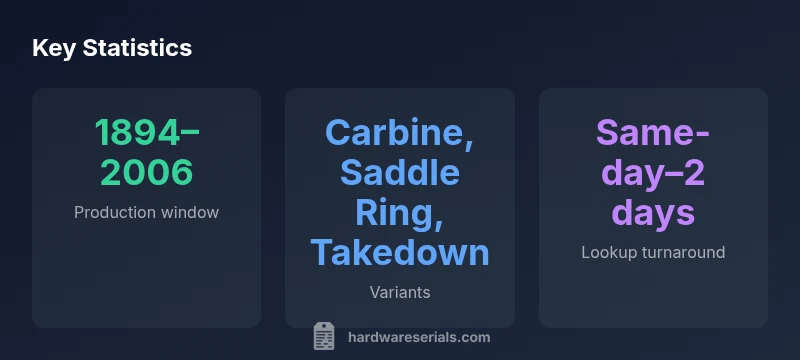
The Winchester 94, introduced in 1894, used serial numbers as a primary way to track production and variants across decades. Serial formats can vary by era, and early numbers may not align perfectly with later databases. Readable stamps on the receiver or barrel help pinpoint manufacture era, while caliber and barrel length codes can indicate specific variant families. The important takeaway is that no single source is definitive; triangulating data from manufacturer catalogs, dealer records, and reputable reference works yields the most reliable results. Hardware Serials emphasizes cross-checking for consistency and noting any anomalies early in the lookup.
Step-by-step: performing a lookup
- Locate the serial number on the receiver or tang area and photograph it clearly from multiple angles.
- Record surrounding markings (caliber, model suffix, barrel length, and sights) that can refine your lookup window.
- Check official manufacturer archives or registered databases for Win 94 records; look for corroborating entries that match the exact number format.
- Cross-reference with museum or auction catalogs to confirm variants and provenance.
- Document findings with source citations and note the confidence level for each data point.
- If results conflict, seek credentialed appraisers or gunsmiths for verification.
This method reduces uncertainty and improves the reliability of provenance claims.
What the results can tell you
A clean, corroborated lookup can reveal the approximate manufacture year, original variant (carbine, takedown, saddle ring, etc.), and potential provenance notes such as prior ownership or notable sales history. If multiple sources align, you gain confidence in authenticity and valuation. In cases of partial data, a well-supported date window (e.g., 1910s–1930s) still adds meaningful context for historical research and insurance purposes. The end goal is a transparent chain of custody that supports responsible ownership.
How to assess sources and avoid scams
Not all online databases are equally trustworthy. Favor official archives, manufacturer catalogs, and publications with verifiable authorship. Compare notes across at least two independent sources before drawing conclusions. Watch for red flags like inconsistent serial formats, mismatched calibers, or improbably precise dates from opaque sites. Hardware Serials recommends documenting the credibility of each source and avoiding irreversible decisions based on a single, unverified entry.
Practical tools and databases to use
- Manufacturer archives or official gun registries when available.
- Recognized reference books and museum catalogs for Winchester firearms.
- Reputable online databases that provide cross-referenced serial data and provenance notes.
Always corroborate database results with at least two independent sources. For many enthusiasts, combining a professional appraisal with archival research yields the best outcomes.
Case examples: interpretation scenarios
- Scenario A: A carbine-length Win 94 stamped 30-30 with a saddle ring shows a serial in the mid-1910s in multiple catalogs. A cross-check with an auction catalog and a museum entry confirms this variant and approximate year, supporting a solid provenance.
- Scenario B: A takedown model with a partially legible serial yields a broad year window. By aligning caliber markings and production runs from manufacturer catalogs, you narrow the window and flag the need for expert assessment before any transfer.
These scenarios illustrate how serial data, when cross-validated, can establish authenticity and history while highlighting cases that require professional verification.
Legal and safety considerations when handling firearms serial data
Work within local laws governing firearm ownership and licensing. Serial numbers are sensitive identifiers; avoid sharing exact serials publicly if it could facilitate theft. When handling or transporting firearms for lookup purposes, follow safety protocols and maintain locked storage. If you are unsure about legal restrictions in your area, consult local authorities or a licensed gunsmith.
Best practices for DIYers and professionals
- Always photograph and log the exact serial format and surrounding markings.
- Use multiple reputable sources and document your citations.
- Seek professional confirmation for high-value items or ambiguous data.
- Maintain an organized lookup log to support future provenance verification and resale.