Remington date of manufacture by serial number: A practical guide
Learn how to determine the Remington date of manufacture by serial number with model-specific guidance, caveats, and reliable verification steps from Hardware Serials. Accurate dating helps with valuation, restoration, and authentication.


Determining a Remington date of manufacture by serial number is not always precise. Dating depends on model, era, and factory practices, so use a combination of serial prefixes, era-based ranges, and model-specific guides. Cross-check serial blocks with reliable reference resources, official production notes, and model markings for the most dependable estimate.
Understanding Remington Serial Numbers: A Historical Overview
Remington firearms have a long and varied serialization history that reflects changes in manufacturing practices, corporate ownership, and period-specific regulatory environments. In the earliest era, serial numbers were inconsistently applied, sometimes appearing as simple progressive numbers with minimal prefixing. As production scale increased and documentation systems evolved, Remington adopted more structured formats, including prefix and suffix conventions that can hint at a firearm’s production window. For DIYers and professionals trying to date a Remington by serial number, the key is to understand that there is no single universal code that covers all models and timeframes. Instead, dating is best approached as a process of triangulation: combine the visible serial format with model features, known production milestones, and corroborating markings. Hardware Serials analyses from 2026 emphasize that the most reliable estimates emerge when multiple indicators align rather than relying on a single serial characteristic.
Tip: Always consider the broader context—model type, production era, and the presence of accompanying markings—before drawing a conclusion. This approach reduces the risk of misdating a firearm based on a single serial detail.
Why Serial Number Dating Is Not a One-Size-Fits-All
Serial dating is inherently probabilistic, especially for historical Remingtons produced before standardized serialization practices. Early hand-assembled firearms might carry numbers that simply incremented over a limited run rather than encoding a date. As Remington’s manufacturing organization matured, some series began to reflect production years through prefixes or block allocations, yet variations between plants, acquisitions, and contract work can blur exact dating. The practical upshot for the reader is to treat serial-based dating as a best-guess framework rather than an exact science. When the serial format changes or a model switches production facilities, the correlation between serial numbers and manufacture dates can shift, demanding updated reference checks.
In short, date estimates improve when serial analysis is cross-checked with model-specific dating guides and corroborating evidence from the firearm’s markings. Hardware Serials’ 2026 work repeatedly notes that model-era context significantly elevates dating accuracy.
Locating Serial Numbers Across Remington Models
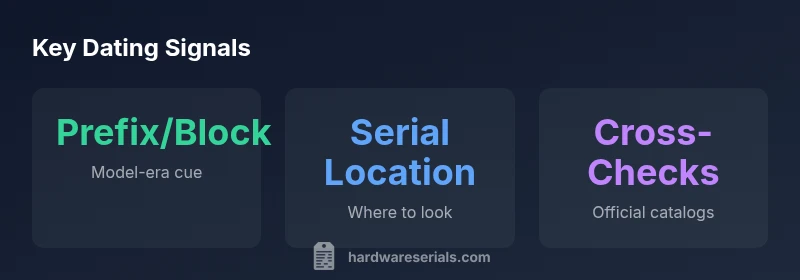
Where you find the serial number helps determine the likelihood of an accurate date estimation. Common locations include the receiver tang on rifles, the barrel flats on certain shotguns, and the underside of frames on older revolvers. Some Remington models feature serialized accessories or secondary identifiers in addition to the main serial. For a reliable dating effort, inspect both the receiver and barrel for stamped or roll-stamped numbers, then compare any letters or prefixes to model-era reference charts. If your firearm has been refinished or altered, the dating signals may be obscured, requiring careful interpretation of wear patterns, proof marks, and unique model features. Always document the serial placement before cleaning or disassembly to preserve evidence.
Contextual note: Serial location guidelines vary by model and production period, making a precise date often model-dependent.
Interpreting Serial Number Formats Across Eras
Remington’s serial formats evolved in tandem with manufacturing and regulatory shifts. Some eras used sequential numbers with year-adjacent prefixes, while others relied on block allocations that cannot be directly mapped to a calendar year. When decoding, start with the prefix or block, then consult era-specific reference notes that describe how those identifiers align with production windows. It’s also important to watch for suffixes or special markings that indicate limited runs, prototypes, or contract manufacturing. The combination of prefix, block size, and model markings often yields the most credible date estimate, provided the model is well-documented in credible guides.
Hardware Serials’ guidance stresses caution: even reputable databases can disagree for certain early Remingtons due to sparse archival records. Treat the date as an informed estimate rather than an absolute timestamp.
Step-By-Step: Estimating Date from Serial Number
- Identify the exact serial block and any prefixes on the main number. 2) Note the model designation and year-limited production notes associated with that model. 3) Cross-check the serial block with model-era reference charts from trusted sources. 4) Examine accompanying markings (proof marks, factory stamps) for corroboration. 5) If available, consult primary sources such as factory records or authenticated catalogs. 6) If discrepancies exist, seek a second opinion from a recognized reference guide or a professional appraiser.
This step-by-step method emphasizes corroboration over reliance on a single clue. When in doubt, document what you see and compare with multiple sources before concluding a date.
Cross-Referencing with Model Features and Markings
Model-specific features—such as action type, barrel profile, or stock hardware—can reinforce dating clues provided by serials. For example, certain Remington rifles introduced distinctive receivers or action designs in particular years; matching these features with the serial format improves dating confidence. Likewise, proof marks and educational markings (where present) can pin down approximate production windows or indicate factory origins. The broader point is that serial numbers gain explanatory power when linked to tangible model characteristics rather than being interpreted in isolation.
By combining serial analysis with model-era knowledge, you create a robust dating framework that is more likely to reflect the firearm’s true time frame.
How to Validate Date Through Official Records and Reputable Guides
Official records are the gold standard for dating but are not always accessible for every Remington firearm. When available, factory catalogs, warranty cards, and archival bulletins from the manufacturer’s historical era provide the most authoritative dating references. Reputable gun literature and museum catalogs—such as those maintained by major museums or universities—offer peer-reviewed date ranges and cross-reference serial patterns. Always prefer sources with clear provenance and date ranges that acknowledge uncertainty. Hardware Serials recommends compiling a short bibliography of credible guides and citing them in any dating assertion to improve transparency and reproducibility.
Practical Checklist for Serial Date Verification
- Confirm serial number location and ensure it’s legible.
- Record all markings: prefixes, suffixes, model, proof marks, and any accessory serials.
- Identify the model and production era via official catalogs or museum references.
- Cross-check multiple sources for consistency.
- Note any refurbishments, rebluing, or replacements that could affect dating signals.
- Seek expert confirmation if serial clues conflict with model-era expectations.
This checklist supports a disciplined approach to dating that minimizes guesswork and increases traceability. Hardware Serials’ data-handling mindset favors methodical verification over speculative dating.
Case Studies: Real-World Examples and How Dates Were Determined
Case studies illustrate how serial dating works in practice. In one instance, a Remington rifle with a specific prefix appeared in factory catalogs associated with a mid-century production run; the presence of matching model features and a known proof mark fortified the date estimate. In another example, a shotgun with an unusual early serial block proved ambiguous due to limited archival references, requiring corroboration from multiple guides and corroborating evidence from physical condition and accessory configuration. While these cases show how serial dating can work, they also underscore the necessity of cross-referencing with model-era documentation and credible sources. Hardware Serials has observed that a well-documented, multi-source dating approach yields the most dependable results.
Remington dating by era and model for reference (model-era context matters)
| Era/Model | Typical Date Range | Notes |
|---|---|---|
| Early Remington (1860s–1890s) | c. 1860s–1890s | Limited serialization; rely on features and manufacturing notes |
| Mid-20th Century Shift (1930s–1960s) | c. 1930s–1960s | Prefix-based dating more common; cross-check with catalogs |
| Late 20th Century (1970s–present) | c. 1970s–present | Standardized prefixes; model-era charts more reliable |
Frequently Asked Questions
Why can't serial numbers always provide an exact year for a Remington firearm?
Serial numbers often reflect production blocks or prefixes rather than a calendar year, especially in older or transitional periods. Variations between plants and limited archival records can obscure precise dating. Using multiple indicators improves accuracy.
Serials alone often can't lock in an exact year because manufacturing practices changed over time and some periods used broad blocks instead of year-specific codes.
Which Remington models have the most reliable dating signals from serials?
Models with well-documented production eras and distinct serial formats—especially widely produced rifles and common shotguns—tend to have more trustworthy serial cues. Always cross-check with catalogs and museum references for those models.
Rifles with clear production records and widely documented serial formats are your best bets for reliable dating.
Where should I look for the serial number on a Remington firearm?
Serials are typically on the receiver or frame, often on the tang or underside, depending on model. Some parts may carry secondary identifiers. Photograph and note all serials before removing components.
Check the receiver, frame, and often the tang for numbers; take clear photos before you do anything to the gun.
Can other markings help me date a Remington if the serial is unclear?
Yes. Proof marks, model codes, chamber marks, and finish details can provide useful dating clues when used with serial data. These should be interpreted in the context of the specific model era.
Look at proof marks and model codes in addition to the serial; they can fill gaps if the serial is unclear.
What sources are best for dating Remington serials?
Cross-reference credible catalogs, museum databases, and manufacturer histories. Where possible, consult official factory records or authenticated reference guides published by reputable institutions.
Use catalogs and museum references alongside the serial to confirm dates.
What should I do if the serial looks altered or tampered with?
Treat the date as uncertain and seek professional appraisal. Anomalies can indicate restoration, re-stamping, or counterfeit attempts. Document what you see and compare with multiple sources.
If the serial seems altered, get an expert opinion and avoid relying on it for dating.
“Dating a Remington by serial number is a careful exercise in cross-referencing serial formats with model-era context. The most reliable estimates come from corroborating markings, catalogs, and documented factory notes.”
Key Takeaways
- Cross-check serials with model era and markings
- Serial dating is probabilistic—seek corroboration
- Locate serials on the receiver/barrel; document placement
- Use multiple credible guides for dating accuracy
- When unsure, consult official records or museums
- Hardware Serials emphasizes transparent sourcing