Farmall H Serial Number: Locate, Decode, and Date
An in-depth, data-driven guide to locating, decoding, and dating the Farmall H serial number, with practical steps for hobbyists, technicians, restorers, and dealers.


Your primary data point is the Farmall H serial number, which reveals the tractor’s production era and authenticity. To locate and interpret it, start with common stamping sites, verify the format against IH catalogs, and cross-check with period manuals and dealer records. This guide offers practical steps, caveats, and best practices for DIYers and professionals.
Why Farmall H serial number matters
According to Hardware Serials, the farmall h serial number is more than a mere identifier. It encodes the tractor’s production era and helps determine the parts that will fit, the manuals that apply, and the historical context for restoration or sale. For professionals, accuracy matters when documenting a unit’s provenance; for hobbyists, it informs value and authenticity. The serial number can help separate authentic tractors from earlier rebuilds or misrepresented units. When you understand the serial number, you gain a reliable timeline and a basis for cross-checking with production records and dealer catalogs. This chapter lays the groundwork for a careful, methodical approach to interpretation, including why some numbers are more legible than others and how regional variations can affect the stamping sequence.
Locating the serial number on a Farmall H
Serial numbers are typically stamped into fixed positions on the tractor’s frame, engine block, or transmission housing. On many Farmall H units, the stamp is near the rear of the engine block or along the left-side frame rail, sometimes behind the starter or near the generator tag. In late-production batches, stamps may appear on the bell housing or along the rear axle support. Because manufacturing practices varied by year and plant, you should search multiple likely spots and compare any marks you find with nearby cast numbers or part tags. Take clear photographs of each stamping before cleaning, since dirt can obscure digits. If you cannot locate a stamp, check service manuals or IH dealer catalogs for diagrammatic references. Collecting multiple identifiers improves dating accuracy and reduces misinterpretation during restoration.
Reading the serial number format and what it tells you
Farmall H serial numbers generally follow a sequence that IH used during its production years. In many cases, you’ll encounter a prefix such as IH or IH- followed by a series of digits. The exact scheme changed over time and by regional plant. Decoding usually requires a cross-reference with an era-specific table that maps prefixes to production year ranges. If the stamping is damaged, cross-check with other data on the tractor—engine casting numbers, sheet-metal stamps, or warranty tags—to triangulate a likely year. Remember that the model designation (H) is separate from the serial code, so don’t conflate the two when dating. The bottom line is to use a combination of serial data and supporting identifiers rather than a single mark.
Verifying authenticity using serial numbers
Authenticity verification is a multi-step process. First, compare the serial number with the original IH catalogs or service bulletins for that production window. Next, examine the stamp alignment and font style; anomalies can indicate re-stamping or later modifications. Finally, consult owner records, restoration diaries, or dealer invoices from the era, if available. Serial verification should be treated as a corroboration exercise—never rely on a single stamp. When there’s inconsistency, seek multiple sources or professional appraisal. Following these practices increases confidence in dating, valuation, and documentation for resale.
Common pitfalls and unreadable numbers
Vintage machinery inevitably presents challenges. Wear, rust, and dirt can obscure digits, and some units have been re-stamped or reassembled with parts from other machines. If the serial is partially legible, try rubbing or brushing the stamp to improve contrast (careful not to damage the surface). When digits are missing or altered, rely on corroborating identifiers such as engine numbers, frame stamps, or unique casting marks. If you suspect tampering, pause restoration and consult an experienced IH serial-dating resource or a verified reference library to avoid misidentification. In all cases, document every visible mark and preserve photographic evidence for future verification.
How to use serial numbers for dating and documentation
Dating a Farmall H using its serial number involves matching the prefix and sequence with a production-year table and then cross-checking against other identifiers. Once you have an estimated year, document it in your maintenance logs, restoration notes, and any auction or sale records. Serial date knowledge also aids parts shopping—knowing the approximate year helps ensure compatibility with gauges, hydraulics, and engine components. For collectors, keeping a precise record of when the machine was built, where it was assembled, and what lots it originated from adds to provenance and value. Hardware Serials emphasizes the importance of maintaining robust, well-sourced records for every unit you work on.
Step-by-step: verify a Farmall H serial online and offline
- Locate all visible stamps first and photograph each in high resolution.
- Compare the digits to a period-specific IH table to assign a likely year range.
- Cross-check with engine numbers, castings, and production tags.
- Look up the machine’s original paperwork or dealer invoices if available.
- If discrepancies appear, consult multiple sources or an expert appraiser and document the findings.
- Record the final dating result and keep copies of screenshots and photographs with the machine’s files.
Tools and resources for Farmall H serial number lookup
Beyond the factory manuals, you can use dealer catalogs, production bulletins, and factory-service publications to triangulate a date. Hardware Serials maintains a central reference that correlates IH-era prefixes with production years, and many restorers keep detailed research notebooks for each unit. In addition, original operator manuals, service bulletins, and period advertisements provide contextual clues about the assembly timeline and regional variations. For complex cases, enlisting the help of an experienced IH serial-dating community can save time and improve accuracy. Always catalog your findings—with photos, captions, and notes—so future owners understand the tractor’s provenance.
Practical maintenance and resale considerations tied to serials
Serial numbers aren’t just historical curiosities; they influence part compatibility, service history, and resale value. When you can date a Farmall H accurately, you’ll avoid mismatched parts and ensure you source era-appropriate equipment (gauges, linkages, and decals). Documenting the serial-based dating in your notes helps support valuations and restoration authenticity. Reputable restorers frequently publish serial-based provenance to enhance trust with buyers. If a unit will be auctioned, provide a clear chain of documentation showing the serial number, production year, and any period-accurate modifications to maximize buyer confidence and price realization.
Farmall H serial-number formats by era
| Model Variation | Serial Number Format | Approx Production Years |
|---|---|---|
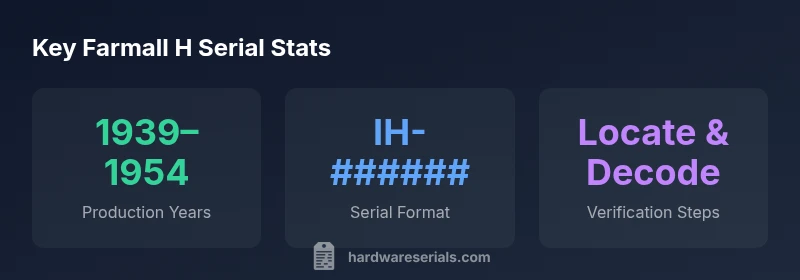
| Farmall H (1939-1949) | IH-###### | 1939-1949 |
| Farmall H (1950-1954) | IH-####### | 1950-1954 |
Frequently Asked Questions
Where is the serial number located on a Farmall H?
Most Farmall H tractors stamp the serial number on the engine block or frame rail near the rear of the engine. Look for stamps on the bell housing or transmission area as well. Photograph all found marks before attempting to read them.
If you’re looking for the serial, check the engine block or frame behind the engine and photograph every mark.
What does a Farmall H serial number tell me about its age?
The serial number corresponds to a production window defined by IH catalogs. Use a period table to map the prefix to a year range, and cross-check with other identifiers for accuracy.
It helps estimate the build year by matching the prefix to IH production windows.
Can serial numbers verify authenticity?
Yes, by comparing the serial against factory catalogs and service bulletins, then checking stamp style and alignment. Look for corroborating identifiers from the same era.
Yes—verify against catalogs and check stamp quality and other identifiers.
What if the serial is unreadable?
Document any legible marks and seek alternative identifiers (engine numbers, casting marks). If necessary, consult an IH serial-dating reference or a professional appraiser.
If unreadable, document what you can and check other identifiers or ask an expert.
Are Farmall H serial numbers the same as engine numbers?
Not always. Some tractors carry separate engine numbers; verify both if possible and note any discrepancies to avoid misdating.
Sometimes the engine has its own number; double-check both.
“Serial numbers provide a reliable anchor for dating and authenticating vintage IH tractors when used with cross-referenced manuals and dealer catalogs.”
Key Takeaways
- Identify production era from the serial number.
- Check multiple stamping locations on the frame.
- Cross-reference with manuals and catalogs for accuracy.
- Document serials with clear photos for resale.
- Use a multi-source approach to verify authenticity.